
3 Ways to Store ROS Topics

· 8 min read
Gracija Nikolovska
Software Developer - C#, Python, ROS

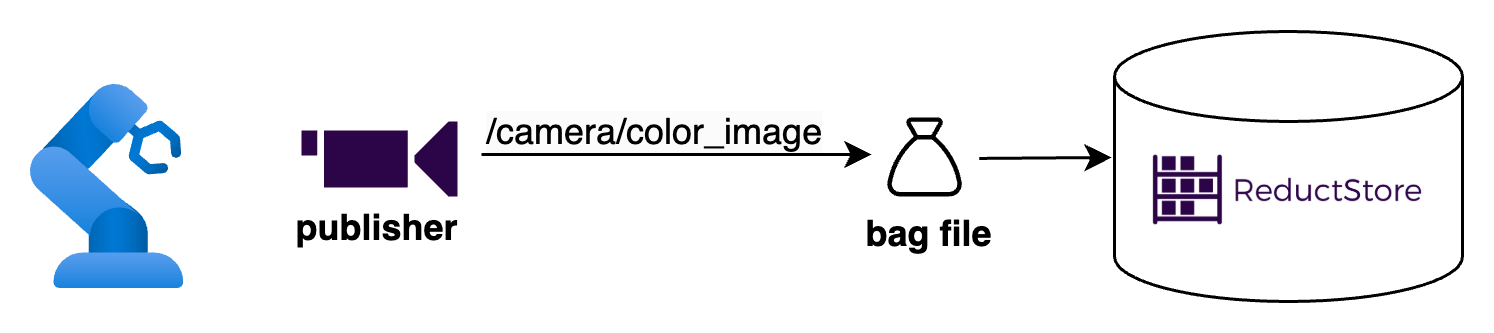
Introduction Diagram

The Robot Operating System (ROS) is a powerful framework for developing and managing robotic systems. It simplifies integration, communication, and development through various tools and libraries. ROS is built around a communication system that uses a publish-subscribe model to connect components, where some, like sensors or cameras, act as publishers, and others, like motors or processors, are subscribers. The data shared between these components is organized into topics.

To make the most of this data, especially when it's needed later for analysis, debugging, or sharing, it's crucial to store it efficiently. In this article, we'll dive into three methods for storing ROS topics, comparing their benefits and limitations to help you choose the best one for your needs. In case you need to gain a broader understanding of how to handle robotics data effectively, make sure to check out our article on storing and managing robotics data first.

Key Component of a Manufacturing Data Lakehouse

· 12 min read
Anthony Cavin
Co-founder & CEO - Data, ML & Robotics Systems

Manufacturing Data Lakehouse Building Block

In today's data landscape, flexibility in terms of performance, cost, and storage availability is at a premium. Data warehouses provide structured, analytical capabilities to process large amounts of data. Data lakes, on the other hand, are known for scalability, and the flexibility to handle vast amounts of unstructured data.

In recent years, however, demand has grown for a robust marriage of these two concepts, leveraging cloud-based technologies and advanced data processing frameworks to store massive volumes of data in raw form (data lake), while also supporting structured querying and analytics (data warehouse). This combined data solution is referred to as a data lakehouse.

The data lakehouse concept is particularly useful for manufacturing, as manufacturing requires fast processing of large amounts of data from numerous sources, including sensors (vibration, temperature, power), employee productivity data (files, spreadsheets, documents), logs, cameras, GPS, and more, creating an unstructured jumble of formats that is difficult to process in a traditional data warehouse.

A data lakehouse is an IT infrastructure that provides a unified solution to handle multiple data formats while still providing the capacity to make sense of this data. It supports intelligent query-based analytics and applies structure to the chaos.

At the same time, ReductStore Cloud Solution is a special type of data storage solution that combines the flexibility of a time series database with the capacity of an object storage. In this article, we will explain these strengths in detail and why we think ReductStore has many advantages as a building block to create a data lakehouse for manufacturing.

In order to present these strengths, we will tie our case to the core components of a strong data lakehouse solution.

The MinIO alternative for Time-Series Based Data

· 10 min read
Anthony Cavin
Co-founder & CEO - Data, ML & Robotics Systems

MinIO vs ReductStore

The amount of data generated world-wide is expanding exponentially, and will only increase further in coming years. In fact, over 90% of the data worldwide has been generated in the last two years, and 40% of data in 2020 was generated by machines. Not to mention that 80 to 90 percent of data is unstructured. Not only is timely processing of said data ever more important, the data itself is often time-stamped and must be handled in a time-based structure. Due to the rise of AI/ML, Robotics, IoT, and edge-computing, solutions that can efficiently leverage much cheaper and plentiful unstructured object/blob storage while maintaining the ability to organize, read, and transmit time-series based data from multiple sources and in multiple formats are in great demand. ReductStore and MinIO are two solutions designed to meet this demand.